

Most people treat a rental agreement like a hotel check-in form: skim it, sign it, and move on. That instinct can be costly. A rental agreement is a legally binding contract, and every clause you overlook is a potential surprise charge waiting to happen. Whether you are hiring a car for a weekend trip, a wedding in Northamptonshire, or a long-term lease, understanding what you are signing protects your money and your peace of mind. This guide walks you through everything: what a rental agreement actually is, what it contains, the terms that trip people up most, and a practical checklist to use before you hand over your signature.
Table of Contents
- Defining a rental agreement
- Essential components of a vehicle rental agreement
- Key terms and stipulations explained
- Common pitfalls and how to avoid them
- Practical checklist before signing a rental agreement
- Where to find reliable vehicle rentals in Northamptonshire
- Frequently asked questions
Key Takeaways
| Point | Details |
|---|---|
| Legal protection | A rental agreement protects both renter and company, defining key rights and responsibilities. |
| Know the details | Check every clause, including insurance and fuel policies, to avoid surprise charges. |
| Ask questions | Clarify any terms that aren’t clear, from mileage limits to excess fees, before signing. |
| Use a checklist | Follow a simple preparation checklist to ensure a smooth, dispute-free hire experience. |
Defining a rental agreement
A rental agreement is far more than a receipt for your booking. As car rental explained on the Sackeycars blog, a rental agreement is a contract defining hire terms, setting out the responsibilities and rights of both the renter and the rental company. It is a formal legal document, not a casual arrangement.
Think of it this way: when you sign, you are agreeing to return the vehicle in the same condition, pay all agreed fees, and comply with every condition listed. The rental company, in turn, commits to providing the vehicle as described and honouring the agreed price. Both sides are bound.
A rental agreement typically covers:
- The rental period (start and end dates and times)
- Total costs, including any additional fees
- Insurance provisions and what is and is not covered
- Mileage allowances and restrictions
- Fuel policy (full-to-full or pre-purchase)
- Conditions for returning the vehicle
- Liability for damage or loss
"A rental agreement is a contract defining the terms of vehicle hire, setting out responsibilities and rights for both parties involved."
You need a rental agreement for any formal vehicle hire, whether it is a single day or a twelve-month lease. There is no such thing as an informal car hire from a registered company. If you are renting, you are signing.
Essential components of a vehicle rental agreement
Knowing what a rental agreement is gives you the foundation. Knowing what is inside it gives you the power to negotiate and protect yourself. Rental agreements typically include terms on insurance, deposit, mileage, and fuel rules, and each section carries real financial weight.
Here are the core components you will find in any standard agreement:
- Driver details — Full name, licence number, and contact information for all authorised drivers.
- Vehicle description — Make, model, registration, and current condition notes.
- Rental period — Exact pick-up and return dates, including times.
- Payment and fees — Base rate, extras, and any applicable taxes.
- Deposit — The amount held and the conditions for its return.
- Insurance — What is covered, what is excluded, and the excess amount.
- Mileage limits — Daily or total mileage cap, and the cost per mile over the limit.
- Fuel policy — Whether you return the car full or pay for a pre-purchased tank.
- Damage liability — Your financial responsibility if the vehicle is damaged.
| Section | What to check |
|---|---|
| Insurance | Excess amount and what voids cover |
| Deposit | Refund timeline and conditions |
| Mileage | Cap per day or total, and overage rate |
| Fuel policy | Full-to-full vs. pre-purchase |
| Return conditions | Acceptable cleanliness and fuel level |
Some agreements also include clauses for eco-friendly rental options, such as restrictions on vehicle idling or requirements for electric vehicle charging. These are becoming more common in 2026 as fleets modernise.

Pro Tip: Always read the return conditions section twice. Late returns, dirty vehicles, and low fuel are the three most common sources of unexpected charges.
Key terms and stipulations explained
Rental agreements are full of industry jargon. Here are the terms that confuse renters most, and what they actually mean.
Excess — The amount you pay out of pocket before insurance covers a claim. If your excess is £500 and the damage costs £300, you pay the full £300.
CDW (Collision Damage Waiver) — An optional add-on that reduces or eliminates your excess in the event of an accident. It is not full insurance; it is a waiver of the company's right to charge you up to the excess amount.
Fuel policy — Full-to-full means you collect the car with a full tank and return it full. Pre-purchase means you pay for a tank upfront and return it empty. Full-to-full is almost always better value.
Early return fee — Some companies charge a penalty if you return the vehicle before the agreed date. Always check this if your plans might change.
Reservation warranty — A guarantee that your specific vehicle category will be available. Without it, you may be upgraded or downgraded.
As noted in the rental location guide, stipulations often include location requirements and booking conditions that vary by pick-up point. And for those hiring for events, special occasion rentals may include clauses for events or extended use that differ from standard daily hire.
| Feature | Short-term hire | Long-term leasing |
|---|---|---|
| Contract length | 1 day to a few weeks | 1 month to several years |
| Mileage limits | Often strict | Usually more flexible |
| Insurance | Included or add-on | Often separate arrangement |
| Flexibility | High | Lower, with exit fees |
| Cost per day | Higher | Lower overall |
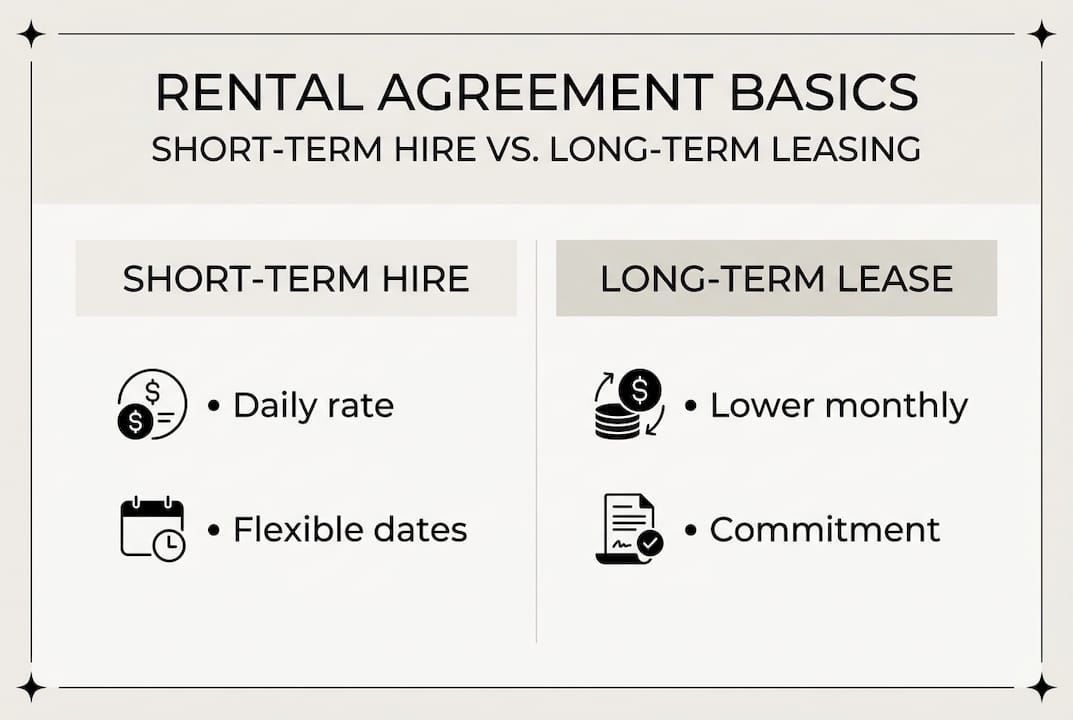
For a full breakdown of leasing versus hiring, the vehicle leasing comparison guide covers the key differences in detail.
Pro Tip: If a term in the agreement is unclear, ask before you sign. Some clauses, including excess amounts and additional driver fees, are negotiable, especially for longer rentals.
Common pitfalls and how to avoid them
Understanding the terms is one thing. Avoiding the mistakes that cost renters money is another. Many renters overlook mileage and insurance details, leading to surprise costs that could easily have been avoided.
Here are the most common errors:
- Not reading the full agreement — Skimming means missing clauses on damage, fuel, and late returns.
- Ignoring the excess amount — A high excess can mean hundreds of pounds out of pocket for a minor scratch.
- Misunderstanding the fuel policy — Returning a pre-purchase tank half-full means you have paid for fuel you did not use.
- Skipping the vehicle inspection — Pre-existing damage not noted on the agreement can be charged to you on return.
- Assuming verbal promises are binding — If a staff member tells you something that is not in the agreement, it is not enforceable. Get it in writing.
"Insurance details should be as clear as the rental price — both protect your peace of mind."
The insurance coverage guide is an excellent resource for understanding exactly what your policy covers before you commit.
Pro Tip: Take timestamped photos of the entire vehicle, including tyres, windscreen, and interior, at both pick-up and return. This takes two minutes and can save you a significant dispute.
Practical checklist before signing a rental agreement
As thorough preparation ensures a smooth vehicle hire and avoids disputes, use this checklist every time you collect a rental vehicle.
- Bring your valid driving licence and a second form of ID.
- Confirm the insurance cover and note the exact excess amount.
- Inspect the vehicle with a staff member present and ensure all damage is recorded.
- Check the fuel level matches what is stated in the agreement.
- Confirm the return procedure: location, time, and fuel requirements.
- Ask about any extras you need, such as child seats, a sat-nav, or a roof rack.
- Read the mileage allowance and calculate whether it suits your planned journey.
Before you sign, ask these questions:
- What is the exact excess if I damage the vehicle?
- Is there a charge for additional drivers?
- What happens if I return the car late?
- Are there any geographic restrictions on where I can drive?
- How is the deposit refunded, and how long does it take?
For those booking premium or exotic vehicles, the premium car booking tips guide offers additional advice specific to high-value rentals, where the stakes in the agreement are even higher.
Where to find reliable vehicle rentals in Northamptonshire
Understanding your rental agreement is the single most effective way to protect yourself, whether you are hiring for a weekend break, a special occasion, or an extended period. Knowing what you are signing means no surprises on return, no disputed charges, and a genuinely stress-free experience.

At SackeyCars, we make the rental process straightforward for individuals and families across Northamptonshire. Based in Rushden, we offer daily, weekly, and long-term hire options, including luxury and exotic vehicles, with clear agreements and transparent pricing. Our team is always on hand to walk you through every clause before you sign, so you leave with confidence, not confusion. Visit our booking page to explore our fleet and start your hire today.
Frequently asked questions
Is a rental agreement legally binding in the UK?
Yes, once signed, a rental agreement is a legally binding contract enforceable under UK law, obligating both the renter and the rental company to honour its terms.
What documents do I need to rent a car in Northamptonshire?
You typically need a valid driving licence, proof of address, and a payment card for the deposit. UK rentals request ID and driving licence as standard, so have both ready at collection.
How can I reduce the excess on a rental agreement?
Purchasing a collision damage waiver or additional insurance options can significantly reduce or eliminate the excess you would otherwise pay in the event of a claim.
Do rental agreements cover special occasions or long-term hires?
Yes, many agreements include or can be adapted to cover special events and extended rentals. Agreements can be customised for weddings, celebrations, or longer-term needs, so always ask your rental provider about tailored options.