

Many travellers believe all car rentals harm the environment equally, but that's a misconception. Sustainable car rental offers choices that dramatically lower carbon emissions through electric vehicles, hybrids, and fuel-efficient cars. The right rental can cut your carbon footprint by nearly half compared to conventional petrol vehicles. This article explains the mechanisms behind sustainable car rental, reveals the real environmental benefits backed by data, addresses practical challenges like charging infrastructure, and provides actionable steps for choosing genuinely eco-friendly options. You'll learn how to navigate greenwashing risks, maximise your rental's sustainability, and make informed decisions that align with your environmental values whilst meeting your transportation needs in Northamptonshire and beyond.
Table of Contents
- Key Takeaways
- What is sustainable car rental and how does it work?
- How sustainable car rental reduces emissions: mechanisms and benchmarks
- Challenges and nuances in sustainable car rental
- How to choose and maximise your sustainable car rental experience
- Explore sustainable car rental options with SackeyCars
- FAQ
Key Takeaways
| Point | Details |
|---|---|
| EV and hybrid focus | Sustainable car rental centres on offering electric vehicles, hybrids and fuel efficient cars to lower tailpipe emissions and overall carbon footprint. |
| Carbon labels and verification | Carbon labels provide transparent information about a vehicle's environmental impact and are independently verified to prevent greenwashing. |
| Emissions reductions potential | EVs charged with low carbon electricity can reduce emissions by approximately 47 per cent nationally. |
| Practical steps | Practical steps include verifying carbon labels, selecting genuinely eco friendly options, and considering charging infrastructure to maximise ecological benefits while avoiding greenwashing. |
What is sustainable car rental and how does it work?
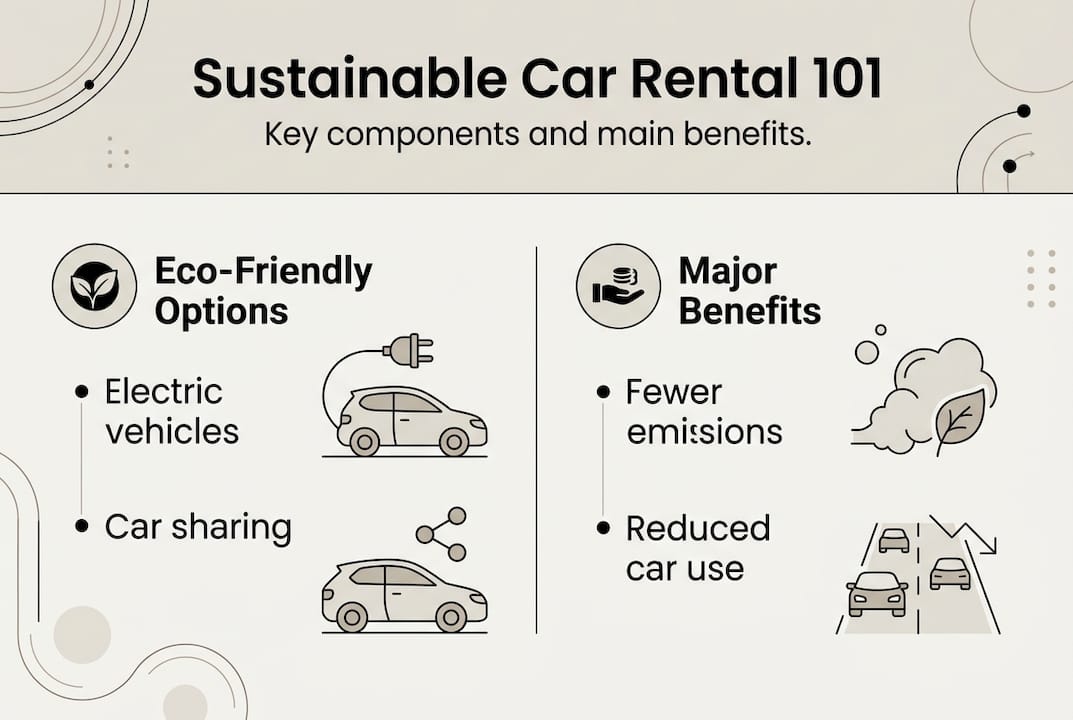
Sustainable car rental centres on providing vehicles that produce fewer emissions than traditional internal combustion engine vehicles. Sustainable car rental primarily involves renting electric vehicles, hybrids, or fuel-efficient cars to reduce tailpipe emissions and carbon footprint, using carbon labels for transparency and verified scopes like the Greenhouse Gas Protocol. This approach transforms how we think about temporary transportation by making environmental impact a core selection criterion alongside price and convenience.
Carbon labels play a crucial role in this system by providing transparent information about each vehicle's environmental impact. These labels help you understand exactly how much CO2 your rental will produce per kilometre, enabling informed comparisons between options. The Greenhouse Gas Protocol and similar frameworks verify these measurements, ensuring accuracy and preventing misleading claims. When you see a carbon label on a rental vehicle, you're looking at independently verified data rather than marketing spin.
Several vehicle categories qualify as sustainable rentals, each offering different emission profiles:
- Electric vehicles produce zero tailpipe emissions, making them the cleanest option when charged from renewable electricity sources
- Hybrid vehicles combine petrol engines with electric motors, reducing fuel consumption and emissions compared to conventional cars
- Highly fuel-efficient petrol or diesel vehicles with advanced engine technology minimise emissions per kilometre travelled
- Plug-in hybrid electric vehicles offer electric-only driving for shorter trips with petrol backup for longer journeys
The benefits extend beyond simple carbon reduction. Companies like SackeyCars are expanding sustainable fleets to meet growing demand from eco-conscious customers. These vehicles often feature newer technology, better fuel economy displays, and quieter operation. You're not sacrificing comfort or performance when choosing sustainable options. Modern electric vehicles deliver instant torque and smooth acceleration whilst producing zero local air pollution, benefiting both global climate and local air quality in Northamptonshire communities.
Pro Tip: Always verify that carbon labels come from recognised standards like the Greenhouse Gas Protocol rather than company-created metrics. Independent verification ensures you're getting accurate environmental information, not greenwashing.
How sustainable car rental reduces emissions: mechanisms and benchmarks
The environmental benefits of sustainable car rentals depend heavily on how and where you charge electric vehicles. EV rentals reduce emissions most when charged from low-carbon electricity, with Korean rental studies showing EV CO2 at 0.005704 tonnes per year versus 0.010763 tonnes for conventional vehicles per vehicle, achieving roughly 47% reduction at national scale. This dramatic difference highlights why electricity source matters as much as vehicle type.
Real-world data from multiple studies provides concrete benchmarks for emission reductions. EV shared services reduce greenhouse gases by 14 to 65% depending on service design and regional electricity grids, whilst EU real-world measurements show conventional petrol vehicles averaging 166 grams CO2 per kilometre and diesel vehicles 170 grams per kilometre. Plug-in hybrid petrol vehicles achieve 131 grams per kilometre, offering a middle ground between full electric and conventional options.
Car sharing amplifies these benefits by improving vehicle utilisation rates. When multiple users share fewer vehicles, total vehicle kilometres travelled decreases across the transport system. European car sharing programmes demonstrate reduced car ownership and modal shifts towards public transport and cycling for some trips. This systemic effect means sustainable car rental contributes to broader transport decarbonisation beyond individual trip emissions.

| Vehicle type | CO2 emissions (g/km) | Annual CO2 (tonnes/vehicle) | Reduction vs petrol |
|---|---|---|---|
| Electric vehicle | 0-50* | 0.0057 | 47% |
| Plug-in hybrid (petrol) | 131 | 0.0089 | 21% |
| Conventional petrol | 166 | 0.0108 | Baseline |
| Conventional diesel | 170 | 0.0110 | Worse than petrol |
*Depends entirely on electricity grid carbon intensity
The variation in emission reductions reflects multiple factors beyond vehicle technology. Grid carbon intensity varies significantly between regions and times of day. Charging your EV rental overnight when renewable energy often dominates the grid produces lower emissions than charging during peak fossil fuel hours. Vehicle size, driving conditions, and user behaviour also influence actual emissions. A large electric SUV driven aggressively will produce more lifecycle emissions than a small hybrid driven efficiently.
Hybrid vehicles occupy an interesting middle position in the sustainability spectrum. Whilst they don't match pure EVs charged from clean grids, they eliminate range anxiety and work everywhere without charging infrastructure. For Northamptonshire residents planning longer trips beyond reliable charging networks, hybrids offer guaranteed emission reductions without the practical complications of current EV infrastructure gaps.
Pro Tip: Request information about your rental company's electricity sources for EV charging. Companies using renewable energy contracts or on-site solar deliver genuinely low-carbon EV rentals, whilst those using standard grid electricity offer smaller but still significant emission reductions.
Challenges and nuances in sustainable car rental
The transition to sustainable car rental faces significant practical obstacles that affect both providers and users. Charging infrastructure remains key for usability, with EV shared services facing challenges from limited chargers and high fleet transition costs. This infrastructure gap creates real limitations on where you can travel with EV rentals and how confidently you can plan longer journeys. Northamptonshire's charging network continues expanding, but coverage remains uneven across rural areas.
High upfront costs slow rental companies' adoption of electric fleets. EVs cost significantly more to purchase than equivalent petrol vehicles, requiring companies to charge higher rental rates or accept lower profit margins during the transition period. This economic reality means sustainable options may cost more, though lower fuel and maintenance costs partially offset the premium. The business case improves as EV prices fall and petrol costs rise, but the transition takes time.
Range anxiety persists as a psychological barrier even as EV technology improves. Modern electric vehicles offer 250 to 400 kilometres of real-world range, sufficient for most daily needs and regional trips. However, the fear of running out of charge far from a charging station deters many potential renters. This concern proves more significant than actual range limitations for most use cases, but perception shapes behaviour regardless of technical reality.
Greenwashing risks include vague environmental claims and self-created labels, whilst offset programmes don't substitute for genuine emission reductions, and battery production creates high upfront emissions. You must scrutinise sustainability claims carefully, looking for specific data and independent verification rather than generic eco-friendly marketing language. Some companies label conventional efficient vehicles as "green" without meaningful emission reductions compared to standard fleet averages.
Battery production emissions represent a genuine environmental cost that lifecycle analyses must account for. Manufacturing lithium-ion batteries requires significant energy and raw material extraction, creating substantial upfront carbon debt. An EV must drive roughly 30,000 to 50,000 kilometres before its total lifecycle emissions fall below an equivalent petrol vehicle, depending on electricity sources and manufacturing locations. This payback period matters less for rental fleets with high utilisation but remains relevant for overall environmental assessment.
Offset programmes offer a tempting but problematic solution. Paying to plant trees or fund renewable energy projects doesn't reduce your rental's actual emissions. Whilst quality offset programmes provide some environmental benefit, they should supplement rather than replace genuine emission reductions through vehicle choice and driving behaviour. Prioritise low-emission vehicles first, then consider offsets as an additional contribution rather than a primary strategy.
Car sharing introduces its own complexity. Whilst shared vehicles reduce total car ownership and associated manufacturing emissions, easy access to cars may increase some trips that would otherwise use public transport, cycling, or walking. Research shows mixed results depending on programme design and user behaviour. Well-designed car sharing reduces overall transport emissions, but poorly implemented systems risk increasing total vehicle kilometres travelled across the transport network.
How to choose and maximise your sustainable car rental experience
Selecting genuinely sustainable car rentals requires systematic evaluation of multiple factors beyond marketing claims. Start by assessing vehicle type based on your specific journey requirements. For urban trips under 200 kilometres with reliable charging access, pure electric vehicles deliver maximum emission reductions. Regional journeys or areas with sparse charging infrastructure favour hybrids or highly efficient conventional vehicles that guarantee completion without range complications.
Follow this step-by-step selection process:
- Verify the rental company provides transparent carbon labels using recognised standards rather than self-created metrics
- Check charging infrastructure availability along your planned route using apps like Zap-Map or Open Charge Map
- Calculate whether your journey distance suits EV range, allowing 20% buffer for unexpected detours or adverse weather
- Compare total trip emissions across vehicle options, factoring in electricity grid carbon intensity for your charging locations
- Evaluate practical factors like boot space, passenger capacity, and comfort requirements alongside environmental criteria
- Confirm the rental agreement includes charging cables, access cards, and clear instructions for public charging networks
Once you've selected your sustainable rental, driving technique significantly affects actual emissions. Use cruise control on motorways to maintain steady speeds and minimise energy waste from acceleration cycles. Plan routes to avoid congestion and unnecessary detours, as stop-start traffic increases energy consumption dramatically. Anticipate traffic flow to coast towards red lights rather than braking hard, recovering kinetic energy through regenerative braking in electric and hybrid vehicles.
Support verified carbon offset or reduction programmes, but prioritise methodologies with independent verification over unsubstantiated claims. Quality programmes provide detailed information about specific projects, third-party verification standards, and measurable outcomes. Avoid programmes making vague promises about tree planting without explaining survival rates, time horizons, or additionality verification. Your money creates more impact supporting proven emission reduction projects than questionable offset schemes.
Car sharing optimises through AI and IoT for route planning, with benchmarks showing 10 to 18% energy and CO2 reductions in Mobility-as-a-Service examples, though policy support for infrastructure and equity remains necessary. Consider car sharing apps that use intelligent routing to minimise empty running and match multiple users efficiently. These systems reduce total vehicle requirements whilst maintaining accessibility, particularly effective in urban areas with high population density.
| Rental type | Emission level | Pros | Cons | Best for |
|---|---|---|---|---|
| Pure electric | Lowest (grid-dependent) | Zero tailpipe emissions, quiet, low running costs | Range limits, charging time, infrastructure gaps | Urban trips, short regional journeys, areas with good charging |
| Plug-in hybrid | Medium-low | Electric mode for short trips, petrol backup, no range anxiety | More complex, higher cost, requires charging discipline | Mixed urban/rural routes, longer journeys, limited charging access |
| Conventional hybrid | Medium | No charging needed, proven reliability, good fuel economy | Still produces emissions, less efficient than plug-in | Long journeys, rural areas, users wanting simplicity |
| Efficient petrol/diesel | Medium-high | Universal fuel availability, familiar technology, lower rental cost | Higher emissions, no zero-emission capability | Budget priority, very long journeys, remote destinations |
Pro Tip: Book your sustainable rental from SackeyCars or companies with transparent fleet management and verified sustainability credentials. Ask specific questions about their electricity sources, fleet age, and maintenance practices to confirm genuine environmental commitment beyond marketing language.
Verify car sharing providers' sustainability credentials before assuming environmental benefits. Look for companies publishing detailed emissions data, using renewable electricity for EV charging, and implementing policies that discourage unnecessary trips. The most sustainable car sharing programmes integrate with public transport rather than replacing it, positioning shared cars as a complement to buses and trains rather than a substitute.

Explore sustainable car rental options with SackeyCars
Northamptonshire residents and visitors now have practical access to genuinely sustainable transport through SackeyCars' expanding eco-friendly fleet. Their commitment to transparent carbon labelling means you can compare vehicles' actual environmental impact rather than relying on vague green claims. The company's growing selection of electric vehicles and hybrids suits various journey types, from quick local trips around Rushden to longer regional travel across the East Midlands.
Local expertise makes a tangible difference when navigating sustainable car rental. SackeyCars understands Northamptonshire's charging infrastructure, recommending vehicles matched to your specific route and providing practical guidance for first-time EV renters. Their team helps you plan charging stops, explains regenerative braking, and ensures you're comfortable with the technology before setting off. This personalised support removes the intimidation factor that deters many people from trying electric vehicles.
Visit the SackeyCars website to explore their sustainable fleet options and book your next low-carbon journey. You'll find detailed specifications, transparent emission data, and straightforward booking processes designed for convenience. Making your travel eco-friendly no longer requires compromising on comfort, reliability, or ease of use. Every sustainable rental contributes to cleaner air in local communities whilst reducing your personal carbon footprint.
FAQ
What vehicles qualify as sustainable car rentals?
Electric vehicles with zero tailpipe emissions represent the most sustainable option, followed by plug-in hybrids offering electric-only driving for shorter distances. Conventional hybrids and highly fuel-efficient petrol or diesel vehicles with advanced engine technology also qualify when they demonstrate significantly lower emissions than fleet averages. The key criterion is measurably reduced carbon output compared to standard internal combustion engine vehicles, verified through transparent carbon labelling.
How does charging infrastructure affect sustainable car rentals?
Adequate local charging stations are absolutely essential for maximising EV rental benefits and user confidence. Limited charger availability restricts trip planning, creates range anxiety, and may force renters towards less sustainable vehicle choices. Northamptonshire's expanding but still incomplete charging network means some rural routes remain challenging for pure electric vehicles. Rapid charger locations along major routes enable longer journeys, whilst destination charging at accommodations and attractions supports tourism applications.
Does car sharing always reduce overall carbon emissions?
Car sharing typically reduces emissions by decreasing total car ownership and associated manufacturing impacts, whilst optimising vehicle utilisation rates. However, easy car access may increase some trips that would otherwise use lower-emission public transport, cycling, or walking. Research shows net emission reductions of 10 to 18% in well-designed programmes, but outcomes depend heavily on implementation details and user behaviour patterns. The most effective schemes integrate with public transport rather than replacing it.
What practical steps can renters take to ensure sustainable travel?
Choose electric vehicles or hybrids with independently verified carbon labels from recognised standards like the Greenhouse Gas Protocol. Plan efficient routes avoiding congestion, use eco-driving techniques including cruise control and gentle acceleration, and charge EVs during off-peak hours when renewable energy often dominates the grid. Support quality carbon reduction programmes with transparent methodologies, but prioritise genuine emission cuts through vehicle choice and driving behaviour over offset purchases. Verify your rental company's sustainability credentials through specific questions about electricity sources and fleet management practices.