

TL;DR:
- Understanding and verifying rental agreements prevents common disputes and unexpected charges.
- Preparing necessary documents and documenting vehicle condition at pickup reduces damage claims.
- Using video evidence and reading agreement terms thoroughly ensures smoother rental experiences.
Getting hit with an unexpected charge after returning a rental car is one of the most frustrating experiences a driver can face. Whether it is a disputed scratch, a confusing fuel policy, or a deposit that takes weeks to return, these problems almost always trace back to one root cause: a poorly understood rental agreement. For residents and families across Northamptonshire, knowing how to read, complete, and verify a car rental agreement is not just useful knowledge, it is genuine financial protection. This guide walks you through every stage of the process clearly, so you can hire with confidence and avoid the disputes that catch so many renters off guard.
Table of Contents
- What is a car rental agreement and why does it matter?
- Essential preparation: What you need before you start
- Step-by-step: How to complete and check a rental agreement
- Avoiding disputes and costly mistakes
- Extra tips for families and business users in Northamptonshire
- Our perspective: What really matters in rental agreements
- Get started with local experts
- Frequently asked questions
Key Takeaways
| Point | Details |
|---|---|
| Understand the agreement | Every part of a car rental agreement has legal and financial implications for you as a renter. |
| Prepare essential documents | Having ID, licence, and payment ready prevents last-minute difficulties and delays at the counter. |
| Document vehicle condition | Taking photos and filling condition reports avoids costly disputes over damage later on. |
| Follow local rules | Rental agreements must meet UK laws and local Northamptonshire provider policies for full protection. |
What is a car rental agreement and why does it matter?
A car rental agreement is a legally binding contract that outlines the parties involved, vehicle details, rental period, fees, insurance, fuel policy, restrictions, and liabilities. Think of it as the rulebook for your hire. Every obligation you and the rental company have to each other is written into this document, which is precisely why reading it carefully is not optional.
Many renters treat the agreement like terms and conditions on a website, scrolling past and signing without a second glance. That approach can be costly. Common disputes include charges for pre-existing damage, disagreements over fuel levels at return, and confusion about mileage limits. Understanding car rental basics before you sign can prevent every one of these problems.
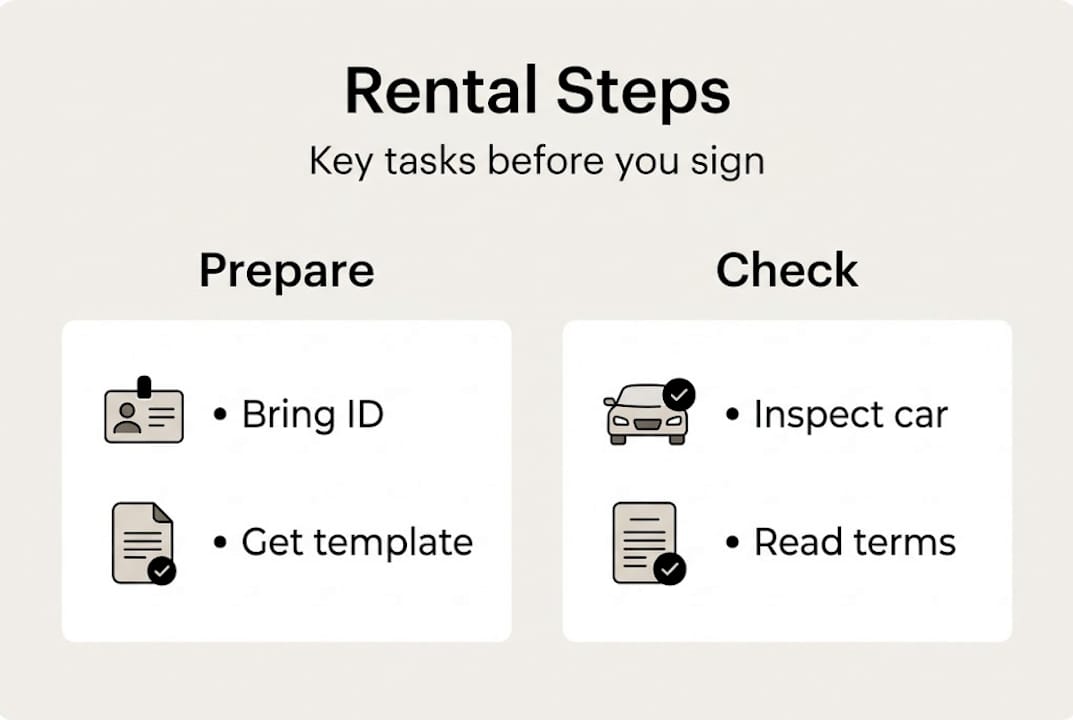
Here is a quick look at the core sections every agreement should contain:
| Section | What it covers |
|---|---|
| Parties and contact details | Renter and company names, addresses, contact information |
| Vehicle details | Make, model, registration, mileage at collection |
| Rental period and fees | Start and end dates, daily or weekly rate, deposit amount |
| Insurance and liability | What is covered, excess amounts, third-party liability |
| Fuel policy | Full-to-full, full-to-empty, or prepaid fuel options |
| Restrictions | Mileage caps, permitted drivers, geographic limits |
Key sections to scrutinise closely include:
- Excess and insurance: Know exactly how much you are liable for if something goes wrong.
- Fuel policy: Misunderstanding this single clause is one of the top sources of unexpected charges.
- Additional driver clauses: Adding a driver without declaring them can void your insurance.
- Mileage limits: Going over an agreed cap can trigger per-mile charges that add up quickly.
Clarity in your agreement saves time, money, and considerable stress. Getting this right from the start is always worth the extra ten minutes.
Essential preparation: What you need before you start
Before you pick up a pen or click through an online form, gathering the right documents and information makes the entire process smoother. Rushing this stage is where many renters create problems for themselves later.

To complete a rental agreement correctly, you need to download or request a template, fill in all party and vehicle details, define the terms covering fees, deposit, mileage, fuel, insurance, and restrictions, document the vehicle condition with photos, then review and sign. Each step depends on having the right information ready.
Here is what you should bring or have to hand:
Personal documents:
- Valid photo ID (passport or driving licence)
- Full UK driving licence (both parts if photocard)
- Proof of address (utility bill or bank statement, no older than three months)
- Credit or debit card for the deposit
Vehicle information to confirm at collection:
- Make, model, and colour
- Registration number
- Vehicle Identification Number (VIN), usually found on the dashboard or door frame
- Current mileage reading
| Document | Why it is needed |
|---|---|
| Driving licence | Confirms legal entitlement to drive |
| Photo ID | Verifies identity of the named renter |
| Proof of address | Required for deposit and insurance purposes |
| Payment card | Holds deposit and processes payment |
If you are comparing local rental deals before booking, check whether the provider requires an international driving permit if you hold a non-UK licence. For those seeking affordable car hire in Northamptonshire, confirming deposit amounts in advance helps you budget accurately.
Pro Tip: At the moment of collection, record a short video walking around the entire vehicle with a member of staff present. Narrate any existing marks or scuffs out loud. This single habit prevents the vast majority of post-return damage disputes.
Step-by-step: How to complete and check a rental agreement
Following a clear sequence when completing or reviewing your agreement removes guesswork and protects you legally. Here is the process broken into manageable steps.
- Verify your identity documents with the rental agent and confirm all personal details on the agreement match your ID exactly.
- Check vehicle details on the form against the actual car in front of you. Registration, colour, and model should all match.
- Confirm the rental period including start time, return time, and the exact location for drop-off. Late returns often trigger additional day charges.
- Review all fees including the daily rate, deposit amount, mileage allowance, and any optional extras such as child seats or GPS.
- Read the insurance section carefully. Note the excess figure and confirm whether your personal insurance or credit card covers any gap.
- Check the fuel policy and make sure you understand whether you need to return the car full or whether you have prepaid.
- Inspect the vehicle together with a staff member and ensure all existing marks are noted on the condition report before you sign.
- Sign only when satisfied. Never feel rushed into signing before you have read and understood every clause.
UK rental agreements must comply with the Consumer Rights Act 2015, which requires that all terms are fair, satisfactory in quality, fit for purpose, and accurately described. Longer hire arrangements are also regulated under the Consumer Credit Act 1974, giving you additional rights if something goes wrong.
Remember: Any term in a rental agreement that appears unfair or unclear can be challenged under UK consumer law. You are not obliged to accept terms that contradict your statutory rights.
For a fuller picture of the local car rental process, it helps to read through provider-specific terms before arriving at the desk.
Pro Tip: Screenshot or photograph every page of the signed agreement and email it to yourself immediately. Having a time-stamped digital copy is invaluable if a dispute arises weeks later.
Avoiding disputes and costly mistakes
Even with a well-completed agreement, disputes can still arise. Knowing the most common triggers helps you stay one step ahead.
Pre-existing damage disputes account for 53% of scratch claims, while 23% of complaints involve no inspection at return, 17% relate to receiving the wrong car, and 12% involve undisclosed damage. Queues longer than one hour at collection cause stress for 11% of renters, and 11% report the overall experience as stressful. These figures make it clear that the process itself carries real risk if you are unprepared.
The most common dispute triggers include:
- Pre-existing damage not noted on the condition report: Always walk around the car and insist every mark is documented.
- Unclear return obligations: Confirm the exact return time and location in writing.
- Fuel level disagreements: Take a photo of the fuel gauge immediately after filling up and again at return.
- Deposit delays: Ask in advance how long the deposit hold takes to release and get it confirmed in writing.
- Mileage overruns: Track your mileage during the hire if you are close to the agreed limit.
To protect yourself against insured rental vehicles disputes, always photograph and video vehicle condition at both pickup and return with a staff member present, and read the full terms online before booking.
Key fact: Reading the agreement online before you arrive at the desk gives you time to raise questions calmly, rather than under pressure at the counter.
Keeping a digital folder with your agreement, photos, fuel receipts, and correspondence creates a clear evidence trail. If a dispute does escalate, this documentation is what resolves it quickly.
Extra tips for families and business users in Northamptonshire
Different rental scenarios call for different approaches, and what works for a weekend family trip may not suit a month-long business hire.
For family travel, the key additions to look for in an agreement include:
- Child seat provision (confirm the correct age and weight group)
- Additional driver clauses for partners or other family members
- Flexible return policies if travel plans change
- Comprehensive insurance with a low or zero excess
For business users, the priorities shift towards:
- VAT receipts and invoicing for expense claims
- Flexible mileage allowances for longer journeys
- Multi-driver options for team use
- Long-term hire rates that reduce the daily cost significantly
In Northamptonshire, rental providers include national names such as Sixt, Enterprise, Avis, Budget, and Arnold Clark, with long-term leasing available through specialists such as Apertus and Silverstone Leasing via personal or business contract hire.
| Scenario | Recommended agreement type | Key add-ons |
|---|---|---|
| Family holiday | Short-term, flexible return | Child seats, extra driver |
| Business trip | Daily or weekly, VAT invoice | Mileage allowance, multi-driver |
| Special occasion | Short-term luxury hire | Full insurance, flexible pickup |
| Relocation | Long-term lease | Mileage cap review, maintenance |
For tailored guidance, our business car rental tips cover the specifics of corporate hire, while our special occasion rentals page explains how to make events memorable with the right vehicle.
Our perspective: What really matters in rental agreements
After years of working in the local car hire industry, we have seen one pattern repeat itself more than any other: renters who rely solely on written condition reports end up in far more disputes than those who use video evidence. A written note saying "minor scuff, rear bumper" is open to interpretation. A thirty-second video is not.
The uncomfortable truth is that most rental disputes are entirely preventable. They happen not because companies are dishonest, but because both sides have different recollections of the same event. Simple communication, a quick video at pickup, and reading the terms before arriving at the desk would eliminate the vast majority of problems we see.
We also believe renters should never feel embarrassed about asking questions at the counter. If a clause is unclear, ask for it to be explained in plain language and noted in writing. For car hire for events or any hire where the stakes feel higher, insist on a full joint inspection regardless of queue length. In our experience, escalation to an ombudsman is rarely necessary when this process is followed from the start.
Get started with local experts
Putting this knowledge into practice is straightforward when you work with a provider who makes the process transparent from the outset. At Sackeycars Ltd, based in Rushden, we believe that a clear, well-explained agreement is the foundation of every positive hire experience.

Whether you are planning a family trip, a business journey, or a special occasion, our team is here to walk you through every clause before you sign. We offer daily, weekly, and long-term hire options with a fleet that suits all needs and budgets. Visit SackeyCars rental services to browse our vehicles, ask questions, and book with confidence. Local, honest, and straightforward car hire in Northamptonshire starts here.
Frequently asked questions
What is the legal minimum for a car rental agreement in the UK?
It must specify the parties, vehicle details, and all key terms, and must comply with the Consumer Rights Act 2015 for fairness. Longer hire arrangements are also regulated under the Consumer Credit Act 1974.
How can I avoid being charged for pre-existing damage?
Take date-stamped photos or video at both pickup and return, and insist on a joint inspection with a staff member. Photo and video evidence at collection and return is the single most effective protection against unfair damage claims.
Which companies offer rental agreements in Northamptonshire?
Major options include Sixt, Enterprise, Avis, Budget, and Arnold Clark, with long-term leasing available through Apertus and Silverstone Leasing via personal or business contract hire.
What is the best way to prepare before picking up a rental car?
Bring your driving licence, photo ID, proof of address, and a credit card, and review the full agreement terms before you arrive. Verifying ID and licence details and photographing the vehicle condition at collection are the two most important steps.